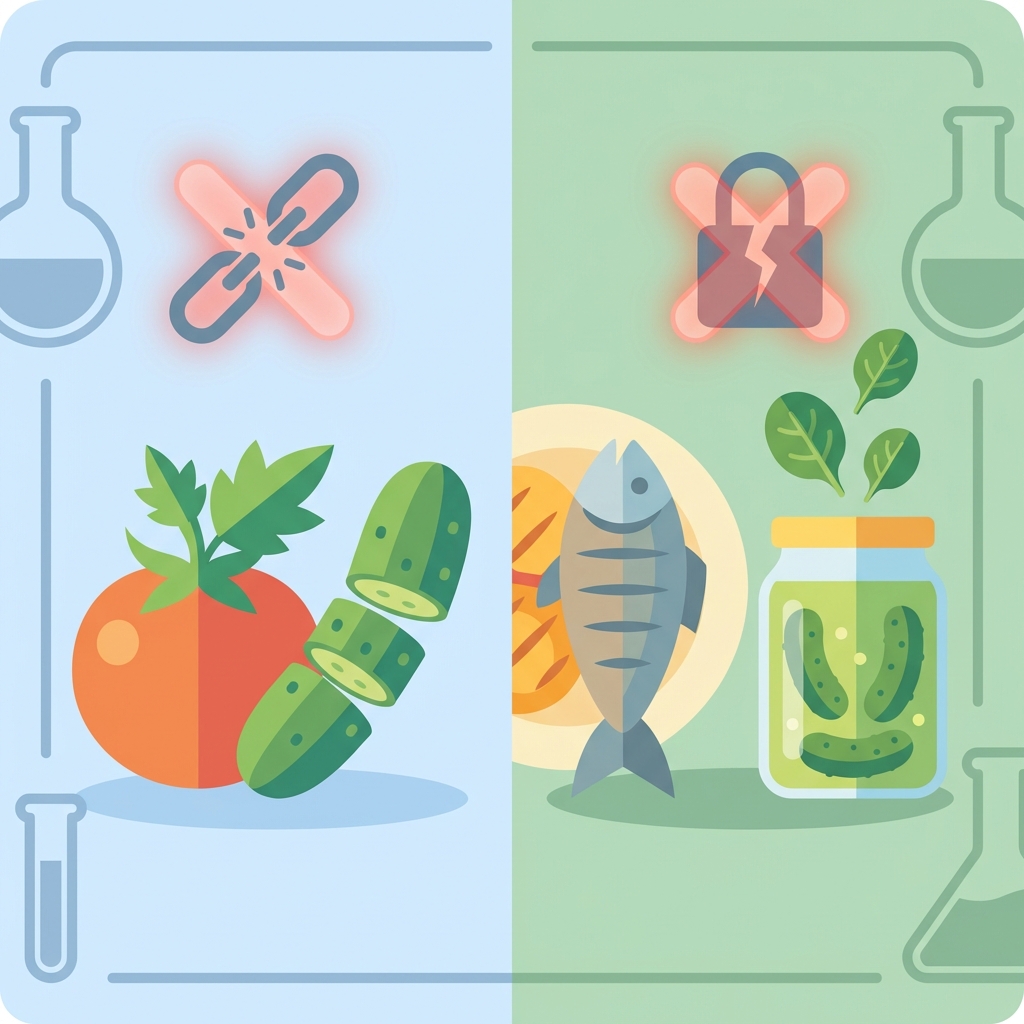
"Eel and Pickled Plum", "Tempura and Watermelon". These are traditional Japanese food taboos known as "Gasshokukin". However, from a modern scientific perspective, many of these are not necessarily bad, and some are merely superstitions.
On the other hand, from a nutritional and chemical perspective, there are combinations that you should actually avoid. Some pairings can waste valuable nutrients or cause indigestion. Here, we introduce scientifically verified "bad food combinations" that are surprisingly unknown.
1. Tomato (Cucumber) × Enzyme-rich Vegetables
Tomatoes and cucumbers are staples of summer vegetables. We often eat them together in salads, but you need to be careful.
Cucumbers (as well as carrots and pumpkins) contain an enzyme called "Ascorbinase". This enzyme works to destroy Vitamin C. This means that the precious Vitamin C contained in tomatoes and other vegetables may be lost when eaten with cucumbers.
Solution: Add vinegar or citrus juice (like dressing). Ascorbinase is weak against acid, so consuming it with these can suppress its activity.
2. Spinach × Bacon
A classic menu item, but this is also a combination to be wary of.
Processed meats like bacon often use "Sodium Nitrite" as a color fixative. Spinach, on the other hand, contains "Nitrate", which changes into nitrite in the body. When these react, there is a risk of generating "Nitrosamines", which are carcinogenic substances.
Also, phosphates contained in bacon can inhibit the absorption of iron and calcium from spinach.
Solution: Blanched bacon to reduce additives, or consuming foods rich in Vitamin C (like lemon) together is said to suppress the formation of rosamines.
3. Whitebait (Shirasu) × Radish (Daikon)
The classic Japanese dish "Shirasu Oroshi". It's refreshing and delicious, but nutritionally it's a bit of a waste.
Whitebait contains "Lysine", an essential amino acid necessary for building body tissues. However, radish contains an antibody that inhibits lysine, so eating them together prevents the absorption of lysine.
Solution: Here too, "Vinegar" is the savior. Adding vinegar can weaken the effect of the inhibitor found in radish.
4. Anaemic People Beware! Iron × Tannins
Do you drink strong green tea or coffee immediately after eating liver or hijiki to supplement iron?
The bitter component "Tannin" contained in tea and coffee binds with iron to form "Tannin Iron", a substance that does not dissolve easily in water. This hinders the absorption of iron in the intestines. In particular, "non-heme iron" found in plant-based foods is said to be easily affected by tannins.
Solution: During or immediately after meals, choose drinks with less tannin like barley tea or roasted green tea, or wait a while (about an hour) before drinking coffee or green tea.
Bonus: Interactions with Medicine
Not just food combinations, but pairings of medicine and food can be critical.
- Grapefruit × High Blood Pressure Medication (Some
types)
Components in grapefruit interfere with the breakdown of the drug, causing the effect to be too strong and potentially lowering blood pressure too much. - Natto × Warfarin (Blood thinner)
Vitamin K, abundant in Natto, helps blood clot, which cancels out the effect of Warfarin, a drug designed to prevent blood clotting.
How was it? It might feel anxious to be told "No", but many can be solved by "Cooking methods" or "Timing". Don't be too nervous, and with a little ingenuity, let's absorb nutrients efficiently and connect them to beauty and health.