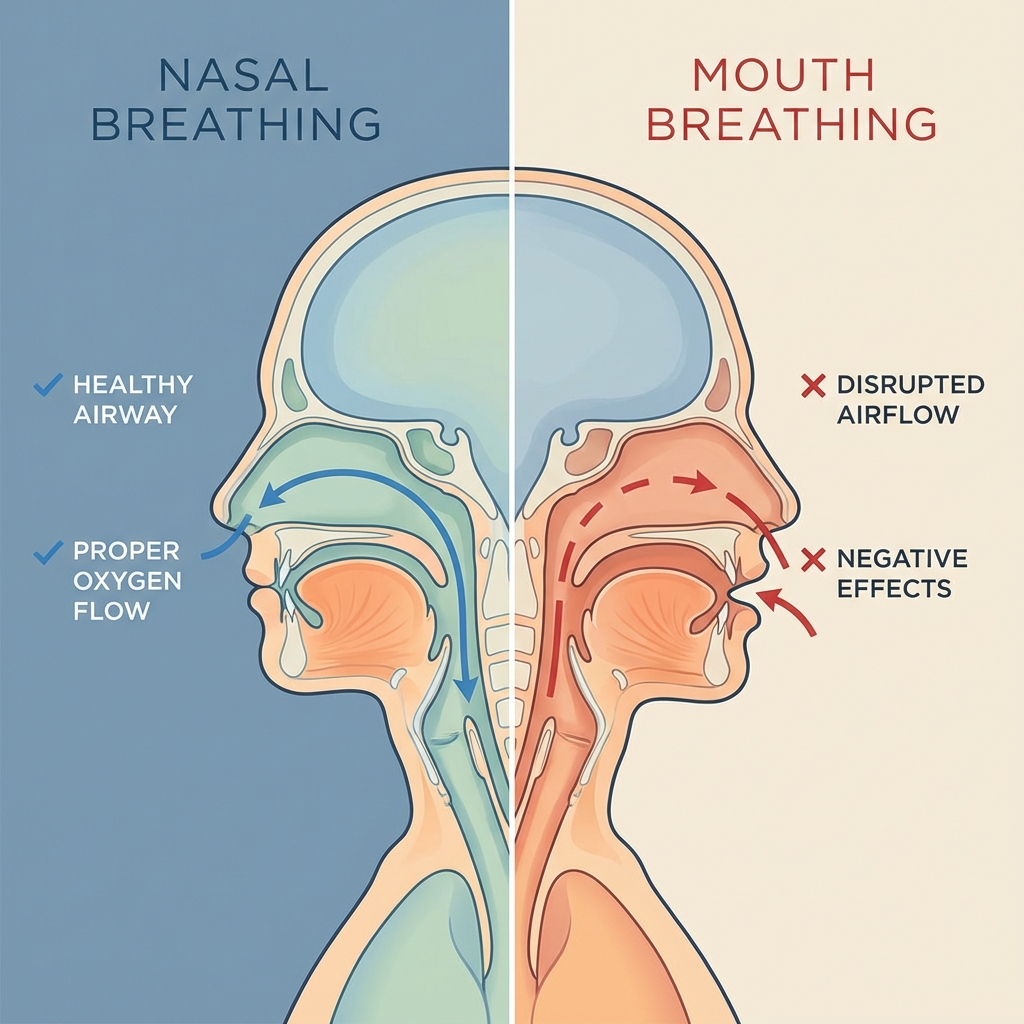
Right now, is your mouth closed? Or is it slightly open? If your mouth unconsciously opens, it might be an important warning sign from your body.
Mouth breathing is a breathing pattern that many people habitually adopt without realizing it, but it actually causes a surprisingly wide range of health problems, including facial bone deformation, weakened immunity, and sleep disorders. In this article, we'll thoroughly explain the "dangers of mouth breathing" warned by dental medicine, otolaryngology, and sleep medicine, along with improvement methods you can start today.
1. 7 Serious Health Risks Caused by Mouth Breathing
① Malocclusion and Facial Bone Deformation
When you continue mouth breathing, your tongue drops from its proper position (lightly touching the upper palate). The tongue acts as a "natural orthodontic device," playing a role in expanding the upper jaw from the inside.
When the tongue position drops, the upper jaw doesn't develop properly, potentially resulting in a characteristic facial appearance called "adenoid facies":
- Face becomes vertically elongated (long face)
- Receding chin
- Poor dental alignment (protruding teeth, crowding, etc.)
- Sagging around the mouth
※What is Adenoid Facies: A characteristic facial appearance resulting from mouth breathing or enlarged tonsils/adenoids (pharyngeal tonsils). Medically also called "Long Face Syndrome."
② Increased Risk of Cavities and Periodontal Disease
Mouth breathing dries out the oral cavity. Saliva has antibacterial properties and constantly cleanses and sterilizes the mouth, but when it dries out, this defense function weakens.
As a result, cavity-causing bacteria and periodontal disease bacteria proliferate more easily, increasing dental problems. Front tooth cavities, in particular, are often attributed to mouth breathing.
③ Sleep Apnea Syndrome (SAS) Risk
Mouth breathing increases the risk of Sleep Apnea Syndrome (SAS). With mouth breathing, the tongue tends to fall back into the throat, narrowing the airway.
※What is Sleep Apnea Syndrome (SAS): A condition where breathing repeatedly stops during sleep. Oxygen deprivation causes severe daytime sleepiness, reduced concentration, hypertension, and increased risk of heart disease.
SAS is not just "snoring"—if left untreated, it increases the risk of heart attack and stroke.
④ Weakened Immunity
The nose is a "natural air purifier." The nasal cavity has the following defense functions:
- Nose Hair: Physically blocks large dust and foreign particles
- Mucous Membranes: Capture bacteria and viruses
- Ciliary Movement: Transport mucus and foreign particles to the throat for expulsion
- Temperature & Humidity Control: Warms and humidifies cold, dry air to near body temperature before sending it to the lungs
With mouth breathing, bacteria, viruses, and allergens reach the throat and lungs directly without passing through these filtration functions. As a result, you become more susceptible to colds, and allergy symptoms tend to worsen.
⑤ Worsening Bad Breath
Dry mouth from mouth breathing is a major cause of bad breath. When saliva decreases, bacteria in the mouth multiply and produce volatile sulfur compounds (VSC), which are malodorous substances.
Morning breath is strong because saliva secretion decreases during sleep, but with mouth breathing, this condition continues all day long.
⑥ Reduced Concentration and Cognitive Function
Mouth breathing is considered less efficient at oxygen intake compared to nasal breathing. Chronic oxygen deficiency impairs brain function, negatively affecting concentration, memory, and judgment.
Especially in children, research suggests that mouth breathing may be associated with reduced learning ability and hyperactivity.
⑦ Worsening Allergy Symptoms
When people with hay fever or dust allergies breathe through their mouth, allergens enter the throat and trachea directly, worsening symptoms. Utilizing the nose's filtration function can potentially reduce allergy symptoms.
2. Why Is Nasal Breathing Important? Scientific Mechanisms
Nitric Oxide (NO) Production
One of the most important benefits of nasal breathing is the production of Nitric Oxide (NO). NO produced in the paranasal sinuses has the following effects:
- Vasodilation: Improves blood flow and increases oxygen delivery
- Antibacterial & Antiviral Action: Prevents pathogen invasion
- Bronchodilation: Makes breathing smoother
※What is Nitric Oxide (NO): A gaseous molecule produced in the body. An important bioactive substance that dilates blood vessels. The 1998 Nobel Prize in Physiology or Medicine was awarded for NO research.
With mouth breathing, you cannot adequately absorb this NO.
Proper Oxygen Supply
Nasal breathing promotes deep breathing using the diaphragm (abdominal breathing). This allows air to reach the lower parts of the lungs, enabling efficient oxygen exchange.
On the other hand, mouth breathing tends to result in shallow chest breathing, reducing oxygen intake efficiency.
3. Are You Okay? Mouth Breathing Self-Check
If any of the following apply to you, you may be a mouth breather:
- ☐ Your mouth unconsciously opens
- ☐ You wake up with a dry mouth or sore throat
- ☐ You snore, or someone has told you that you do
- ☐ You're concerned about bad breath
- ☐ You have chronic nasal congestion
- ☐ Your lips dry out easily
- ☐ You can't concentrate, or feel sleepy during the day
- ☐ You have poor dental alignment, or it's getting worse
If three or more apply, you likely have a mouth breathing habit.
4. Start Today! Nasal Breathing Improvement Training
① Aiube Exercise
An exercise developed by Dr. Kazuaki Imai, an internal medicine physician in Fukuoka, to strengthen the muscles around the mouth:
- "Ah": Open your mouth wide (1 second)
- "Ee": Stretch your mouth wide horizontally (1 second)
- "Ooh": Push your mouth forward (1 second)
- "Tongue out": Stick your tongue out as far down as possible (1 second)
This exercise strengthens the orbicularis oris muscle (muscles around the mouth) and tongue muscles, naturally increasing the strength to keep your mouth closed.
② Be Aware of Proper Tongue Position
The correct tongue position is at a place called the "spot":
- The tip of the tongue lightly touches just behind the base of the upper front teeth (anterior hard palate)
- The entire tongue lightly contacts the upper palate
- The tongue is relaxed, not tense
By constantly being aware of this position, you'll naturally breathe through your nose.
③ Mouth Taping During Sleep
A method of lightly closing the mouth with medical tape or surgical tape during sleep. By forcing nasal breathing, sleep quality improves and morning dry mouth is reduced.
⚠️ Precautions:
- Don't use if you have severe nasal congestion
- Apply lightly in a vertical direction (don't completely seal)
- Using dedicated mouth-closing tape is safer
④ Nasal Irrigation (Nasal Washing)
If nasal congestion is causing mouth breathing, nasal irrigation is effective. Using saline solution to wash the nasal cavity removes pollen, dust, and mucus.
※What is Saline Solution: A salt solution with the same osmotic pressure as body fluids (about 0.9%). Using tap water directly causes a stinging sensation, so always use saline solution or dedicated washing liquid.
⑤ Visit an ENT Specialist
If you have chronic nasal congestion, conditions such as allergic rhinitis, sinusitis, or deviated nasal septum may be hidden. We recommend first getting examined by an otolaryngologist.
You might think "it's just breathing," but we breathe about 20,000 times a day. Whether each breath is through the mouth or nose creates a significant health difference in the long term.
Especially for growing children, mouth breathing directly affects facial bone development, making early improvement crucial. Even for adults, changing awareness starting today can improve sleep quality, immunity, and concentration.
Why not start by being aware of the "Aiube exercise" and "tongue position"? Small habit changes might greatly transform your health.